

No one stands still in print and packaging, not when brands demand lightning-fast turnarounds, custom runs, and flawless results with every job.
For prepress teams, it’s a race against time and error, and the stakes only get higher as files, regulatory demands, and customer expectations keep piling up. Traditional manual quality checks can’t keep pace; slowing teams down, inflating costs, and opening the door for costly mistakes.
If you want to win in 2026, working smarter isn’t just an option, it’s essential.
The clear answer? Automation, powered by robust APIs. In 2026, APIs won’t just support prepress quality, they’ll define it.
From eliminating bottlenecks to empowering your team to scale operations fearlessly, APIs are fast becoming the backbone for next-generation quality control in print and packaging.
Cracks in Traditional Prepress Quality Control
For decades, prepress quality has been synonymous with keen expertise and detail-driven manual checks. While the industry’s skilled professionals are irreplaceable, even the sharpest eyes get tired, or miss a detail under pressure.
Manual quality checks are slow by nature. Reviewing large, complex files, word by word, line by line, code by code, creates significant drag in otherwise efficient workflows.
Surge in job volume? You’re forced to add more staff, eat extra costs, or rush your inspection and risk errors slipping through.
Miss a typo, a mislabeled barcode, or a graphic out of alignment? That’s more than a headache. It’s a recall, a costly rerun, and a hit to your brand reputation.
Human inspection, no matter how diligent, can’t guarantee total accuracy at scale. Fatigue, repetition, and rising complexity all chip away at reliability. As jobs grow, these cracks widen. It’s time for a new solution.
Step Into the Future: The API Advantage
APIs (Application Programming Interfaces) break down silos by connecting the tools and platforms your team already relies on. Instead of juggling manual handoffs between disconnected systems, APIs form digital bridges, seamlessly linking your design software, workflow engines, digital asset management, and more.
This is your golden ticket to prepress quality automation. Imagine, with a single integration, your files trigger automated quality checks, instantly and accurately. The moment an artwork is uploaded, it’s whisked through a battery of inspections, every critical element verified, with no team member stuck in the bottleneck. Quality assurance becomes proactive, standardized, and boldly efficient.
And this isn’t a distant dream. API-driven prepress quality automation is available right now, and it’s redefining what’s possible for print and packaging teams worldwide.
Quality Checks Reinvented: The API Way
APIs unlock the true power of automated QA by transforming the most painstaking prepress quality checks into fast, reliable, and repeatable processes.
Automated Artwork & Text Verification
Stop wasting hours in manual file comparisons and spell checks. APIs let you automate artwork and text verification in seconds, digitally flagging changes in content, fonts, graphics, or colors between versions. It’s digital precision that all but eliminates the risk of unnoticed deviations or embarrassing typos, and lets your team focus on higher value work.
Barcode, QR Code, and Braille Checks
Barcode and QR code verification is non-negotiable. One error can grind distribution to a halt and damage relationships with customers. API automation ensures your codes are scanned, graded, and validated against industry standards (like ISO) every single time. The same goes for braille. An API checks placement, translation, and formatting for regulated accessibility, ensuring your packaging meets every requirement before it ever hits the press.
Effortless Scale for High Volumes
Got hundreds (or thousands) of files to inspect each week? API-powered automated QA makes handling scale a breeze. You can run parallel checks across any number of assets, with no dip in accuracy and no ballooning costs. This is prepress quality automation at its boldest: reliable, repeatable, and ready to grow as you do.
Transforming Prepress with Verify API
Ready to move your workflow from reactive to remarkable? Enter Verify API from GlobalVision.
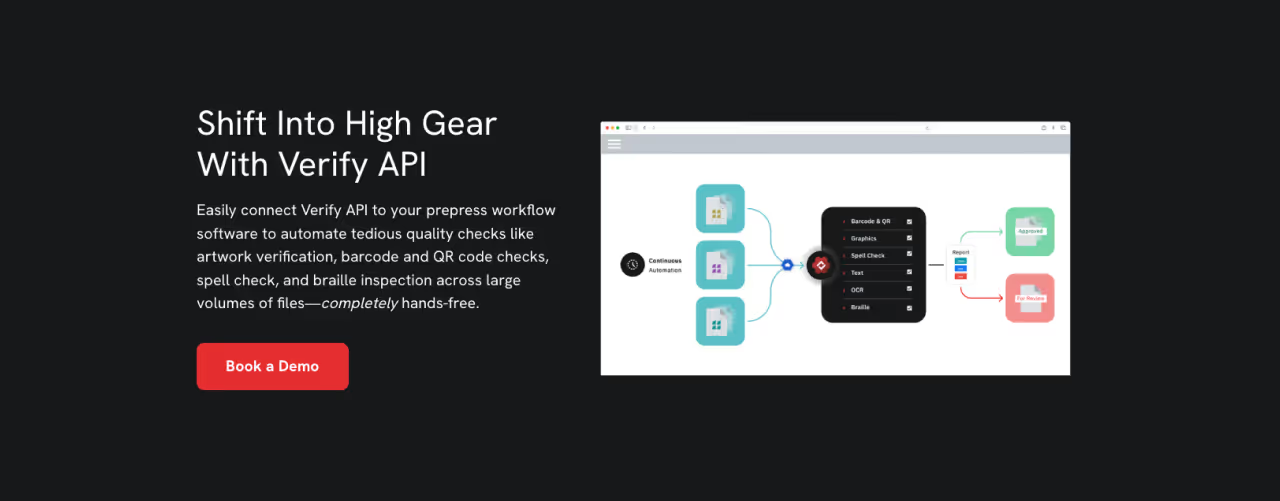
Verify API is engineered to give prepress leaders complete control, automating critical quality checks directly inside your current ecosystem, without complex overhauls or endless retraining. From artwork comparison to barcode and braille verification, all your key QA processes become automated, integrated, and relentless in their accuracy.
With Verify API, your prepress operation can:
- Streamline quality checks: Eliminate bottlenecks and slash inspection times.
- Cut out costly errors: Flag issues before they reach the press, saving you money, materials, and reputation.
- Scale with confidence: Keep up with demand, no matter how many files you process.
- Seamlessly integrate with your stack: Tie into DAM, MIS, PIM, Esko, CLOUDFLOW, and other platforms already in your workflow.
In short: embracing an API-centric workflow isn’t just an update, it’s a leap forward. Automation becomes your competitive edge, your guarantee for prepress quality, and your foundation for growth.
The teams that thrive in 2026 and beyond will be those who boldly automate, embracing APIs as the heartbeat of error-free, high-volume, high-value print and packaging.
Frequently Asked Questions