

Let's talk shop. If you run packaging production, you already know quality control (QC) isn't the glamorous part of the job.
It's the part that saves your job. It's the difference between a launch that ships clean and a recall that eats your quarter.
So let's get specific about what quality control in packaging production actually involves, where it breaks down, and how the best teams have quietly rewired their process to catch errors before they ever cost a dime.
What Quality Control in Packaging Production Really Means
Quality control in packaging production is the systematic process of verifying that every artwork file, label, and printed component matches its approved master, exactly, before it goes to press and after it comes off the line.
That's the textbook version. In practice, it's broader and messier. Real QC spans:
- Content accuracy: text, copy, ingredient lists, dosage details, and legal statements
- Graphics and artwork: logos, layout, dielines, and design elements matching the approved file
- Barcode integrity: codes that scan and decode correctly at every checkpoint
- Color fidelity: brand colors holding true across substrates and print runs
- Regulatory elements: allergen callouts, warnings, symbols, and multi-language text
- Structural compliance: the physical package meeting spec
Miss any one of these, and the package fails, regardless of how polished the other five look. QC isn't a single gate at the end. It's a discipline that lives across the entire prepress and print workflow.
Why Packaging QC Is Harder Than It Looks
Here's what makes packaging quality control genuinely tough, and why teams that treat it casually get burned.
The SKU count is relentless. You're not checking one label. You're managing hundreds, sometimes thousands, each with variants for size, region, flavor, and promotion. Every variant is a fresh chance for something to slip.
Every market rewrites the rules. Ship into the EU and you inherit allergen highlighting and multi-language requirements. Ship into the US and the FDA and USDA set the terms. Each region layers on its own format, language, and content demands, and you're often reconciling all of them at once.
The revisions never stop. Recipes change. Regulations update. Marketing swaps a claim. Each edit resets the risk clock, and a version that was perfect last month can be non-compliant today.
The error tolerance is zero. In most industries, a small mistake is a shrug. In packaging, a transposed digit or a missing warning becomes a recall, a fine, or a safety incident, multiplied across every unit in the run.
Put those four pressures together and you get the real challenge: maintaining flawless accuracy at high speed and high volume, without letting QC become the bottleneck that blows your launch date.
The Packaging Errors That Actually Cost You
Not all mistakes are created equal. These are the ones that show up most often on the production floor, and hit the hardest when they escape.
The pattern is worth sitting with: nearly every costly error traces back to a version that wasn't verified against its approved source. The mistake was catchable. It just wasn't caught in time.
Where Manual Inspection Runs Out of Road
Manual proofreading built this industry, and skilled reviewers are genuinely good at their craft. But candidly? The math no longer works.
Consider what you're asking a human reviewer to do: compare dense files character by character, catch a single misplaced comma buried in fine print, verify text in languages they don't speak, and confirm color and barcode accuracy, across hundreds of SKUs, on a deadline, all day long.
The limits are structural, not personal:
- Fatigue is real. Tired eyes skip subtle character swaps and spacing shifts. The tenth review of the day isn't as sharp as the first.
- Volume beats stamina. Manual checks simply can't scale to modern SKU counts without adding headcount you don't have.
- Language creates blind spots. You can't reliably proof a Polish or Japanese label by eye if you don't read Polish or Japanese.
- Consistency wobbles. Two reviewers, one file, two different verdicts. That variability is a liability all its own.
None of this is a knock on your team. It's simply the ceiling of what manual review can deliver when the workload outpaces human capacity. Smart teams stop fighting that ceiling and start engineering around it.
How Automated Proofreading Changes the Game
Here's where the story turns. Automated inspection tools don't replace your expertise, they amplify it. They take the mechanical, high-volume, error-prone comparison work off your reviewers' plates and do it with machine precision, every single time.
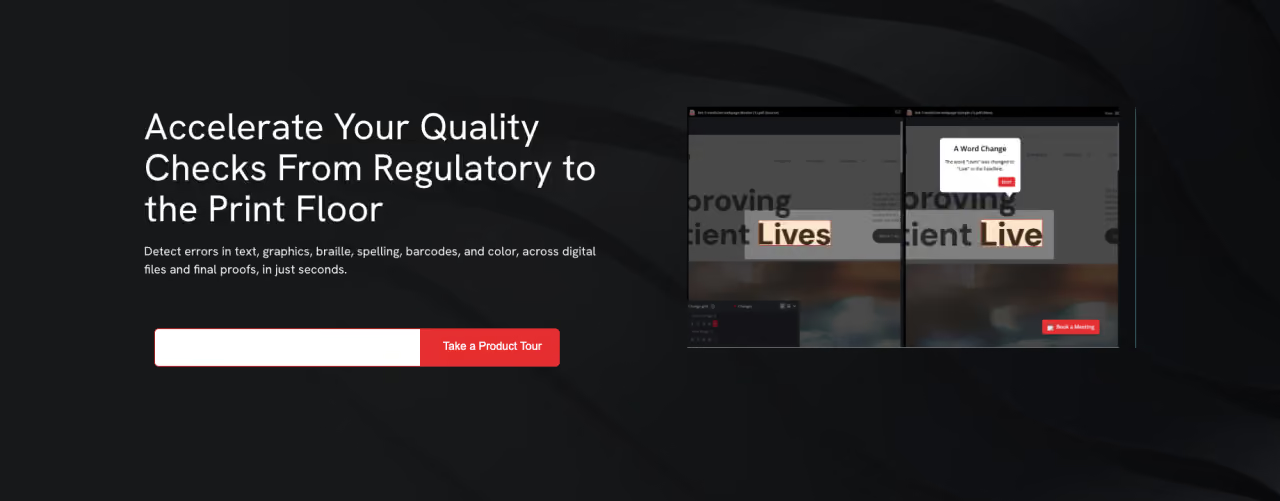
Point an automated proofreading system at a file, and it compares that file to the approved master with pixel- and character-level accuracy. What it verifies:
- Text and spelling across every language version, including ones no one on your team reads
- Graphics and artwork measured against the approved master, catching shifts the eye glosses over
- Barcodes and codes confirmed to scan and decode correctly
- Braille inspected for regulated markets
- Color and registration checked against brand and regulatory standards
- Spelling and grammar tuned to your industry's terminology
The payoff is threefold. You get speed, because a check that took a reviewer 15 minutes now takes seconds. You get consistency, because every file faces the same rigorous, repeatable standard, no fatigue, no mood, no guesswork. And you get scale, because the tool doesn't care whether it's checking ten SKUs or ten thousand.
A Practical Framework for Building QC Into Prepress
Knowing the tools exist is one thing. Wiring them into your workflow is where the wins happen. Here's a framework the leading teams use, straightforward, repeatable, and built for scale.
1. Lock in a single source of truth.
Designate one approved master file per component. Every inspection compares against it. No ambiguity about what "correct" means, no chasing the latest version through email threads.
2. Inspect early, inspect often.
Run an automated check the moment artwork arrives, and again after every revision. Catching a deviation in prepress costs a fraction of catching it on press, and a tiny fraction of catching it on the shelf.
3. Make a clean inspection a hard gate.
No file advances to platemaking without a passed automated check. Turn QC from a courtesy into a requirement. That single rule eliminates most escaped errors on its own.
4. Standardize what gets checked.
Define your inspection criteria, text, graphics, barcodes, color, allergens, braille, and apply the exact same standard to every file. Standardization kills the reviewer-to-reviewer variability that lets errors slip.
5. Verify every market version independently.
Treat each regional and language variant as its own file requiring full verification. Automated text comparison makes multi-language checks fast and reliable, even for scripts your team can't read.
6. Log everything.
Keep a complete record of every inspection, revision, and approval. It sharpens your process over time, and it's exactly the documentation you'll want when questions come up later.
Build these six steps into prepress and QC stops being the frantic scramble before a deadline. It becomes a quiet, dependable strength that scales right alongside your SKU count and market reach.
The Bottom Line
Quality control in packaging production isn't about catching more errors by trying harder. It's about designing a workflow where errors get caught automatically, consistently, and early, long before they reach a press or a shelf.
The leading teams figured this out. They stopped leaning on manual review to do work it was never built to handle at scale, and they built automated inspection into the bones of their prepress process.
The result speaks for itself: fewer reprints, faster launches, higher compliance rates, and a whole lot less firefighting. That's what modern packaging QC looks like, and it's well within your reach.
Frequently Asked Questions