Pharmaceutical compliance is how drug manufacturers meet the laws, Good Manufacturing Practice (GMP) rules and guidelines that govern how medicines are made, tested, labeled and distributed. It matters because one error in a medicine can harm patients at scale, so regulators allow almost no margin. It affects drug makers, contract manufacturers, packaging and labeling teams, distributors and their suppliers.
What is Pharmaceutical Compliance?
Pharmaceutical compliance is the practice of meeting every legal and regulatory requirement for developing, manufacturing, testing, packaging, labeling and distributing medicines, and proving it with complete records. At its core sits Good Manufacturing Practice (GMP), the rules that make sure drugs are consistently made to their approved quality standards.
It is the most demanding form of regulatory compliance. Drug makers must follow rules that cover facilities, equipment, people, materials, data, labels and the supply chain, and regulators can inspect any of them at any time.
Pharmaceutical compliance also overlaps with the wider field of life sciences compliance, which includes biotech, medical devices and diagnostics.
Why are Drug Manufacturers Held to the Strictest Rules?
Three facts explain why pharma is more tightly regulated than almost any other industry.
1. Quality cannot be tested into a drug. Testing samples cannot prove every tablet or vial is right. Regulators therefore control the whole process, from raw materials to release, so quality is built in at every step.
2. Errors reach patients at scale. One wrong strength on a label or one contaminated batch can affect thousands of patients. Many users are already sick, elderly or children, so the margin for error is close to zero.
3. History taught hard lessons. Modern drug law was written in response to tragedy. In 1937, a toxic solvent in Elixir Sulfanilamide killed over 100 people, leading to the 1938 Federal Food, Drug, and Cosmetic Act. The thalidomide birth defects crisis led to the 1962 Kefauver-Harris Amendments, which required proof of effectiveness.
Enforcement is rising, not easing. FDA's drug center issued 303 warning letters to drug and biologics manufacturers in fiscal year 2025, a 59% increase on the 190 issued in FY2024.
Which Regulations Govern Pharmaceutical Manufacturing?
Drug makers selling globally must meet several overlapping rulebooks. These are the core ones.
What is changing: the EU released draft revisions of GMP Chapter 4 (Documentation) and Annex 11, plus a new Annex 22 on artificial intelligence, in July 2025. They are still drafts, but they signal much tighter expectations for digital records and data integrity.
FDA vs. EMA: How do US and EU Pharma Rules Compare?
The two largest regulators share the same goal but work differently.
Companies that sell in both markets usually build one quality system that meets the stricter rule on each point.
What are the Core Areas of Pharmaceutical Compliance?
Inspectors look at five areas most closely. Weakness in any one can trigger findings.
- GMP and the quality system. An independent quality unit, validated processes, change control, deviation handling and CAPA.
- Data integrity. Records must follow ALCOA+ principles: attributable, legible, contemporaneous, original and accurate, plus complete, consistent, enduring and available. Shared logins, missing audit trails and backdated entries are classic failures.
- Documentation and document control. Approved, version-controlled SOPs, batch records and specifications. Learn how teams manage this in our guide to document control in regulated industries.
- Labeling and packaging. Every label, carton and insert must match the approved content exactly, in every language and market. One wrong strength, expiry date or lot number can force a recall.
- Supply chain and serialization. Qualified suppliers, secure distribution and package-level traceability under DSCSA and FMD.
Pharmacovigilance, the monitoring of drug safety after approval, completes the picture for marketing authorization holders.
What Happens When Pharma Companies Fail Compliance?
Enforcement escalates in steps, and each step costs more than the last.
Labeling is a persistent weak spot. An analysis of FDA enforcement data counts 1,433 drug recalls caused by labeling errors since 2006, from label mix-ups to wrong strengths and expiry dates.
Data integrity is another. Third-party reviews of FY2025 warning letters found data integrity concerns in about 15% of letters overall, and in about 60% of letters to sites in India.
How do Drug Manufacturers Stay Compliant? 7 Steps
Leading pharma teams treat compliance as a daily discipline, not an inspection event.
- Build a strong quality system. Follow ICH Q10: an empowered quality unit, management review and clear escalation paths.
- Apply risk-based thinking. Use ICH Q9 quality risk management to focus controls and audits where patient risk is highest.
- Protect data integrity. Use validated systems with audit trails, unique user logins and regular data reviews.
- Control every document. Keep SOPs, batch records and specifications approved, versioned and traceable.
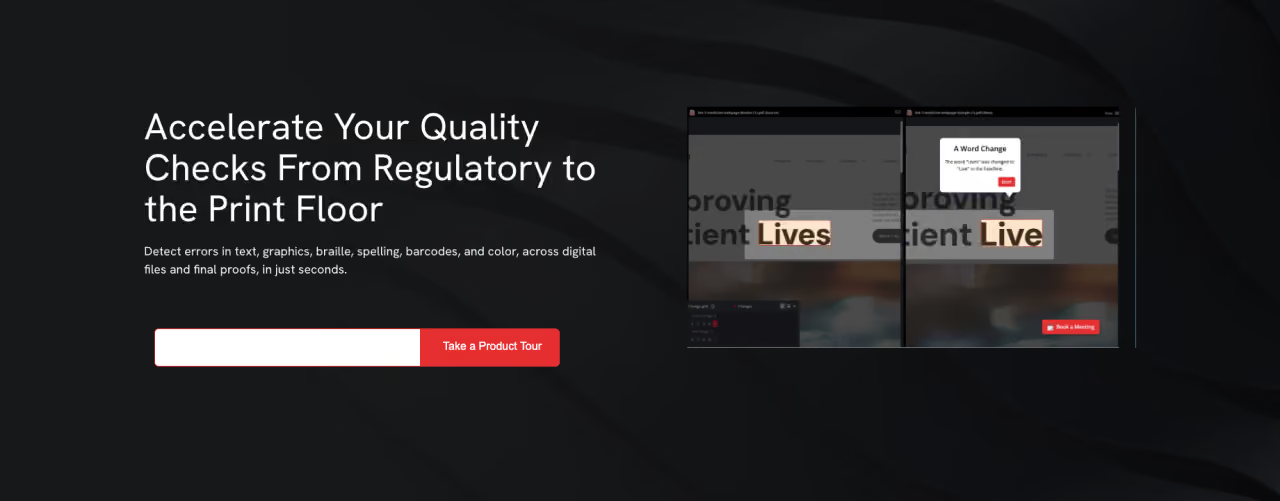
- Verify labels and artwork. Compare every new label, carton and insert against approved content before print and release, using automated proofreading rather than manual checks alone.
- Qualify suppliers and partners. Audit API suppliers, contract manufacturers and packaging vendors. FDA holds product owners responsible for their contractors.
- Stay inspection-ready. Run mock inspections and internal audits, and keep evidence current. See how teams prepare in our guides to inspection readiness and compliance audits.
How Does Pharmaceutical Compliance Compare With Other Industries?
Pharma sits at the top of the regulatory scale. This comparison shows why.
Conclusion: Strict Rules Protect Patients
Drug manufacturers operate under the strictest rules in industry because their products go straight into people's bodies. Pharmaceutical compliance is how they prove, batch by batch, that every medicine is what its label says it is.
The teams that succeed build quality into every step: strong quality systems, clean data, controlled documents and error-free labeling. To see how pharma fits into the wider picture, read our complete guide to regulatory compliance management.
Pharmaceutical Compliance FAQs