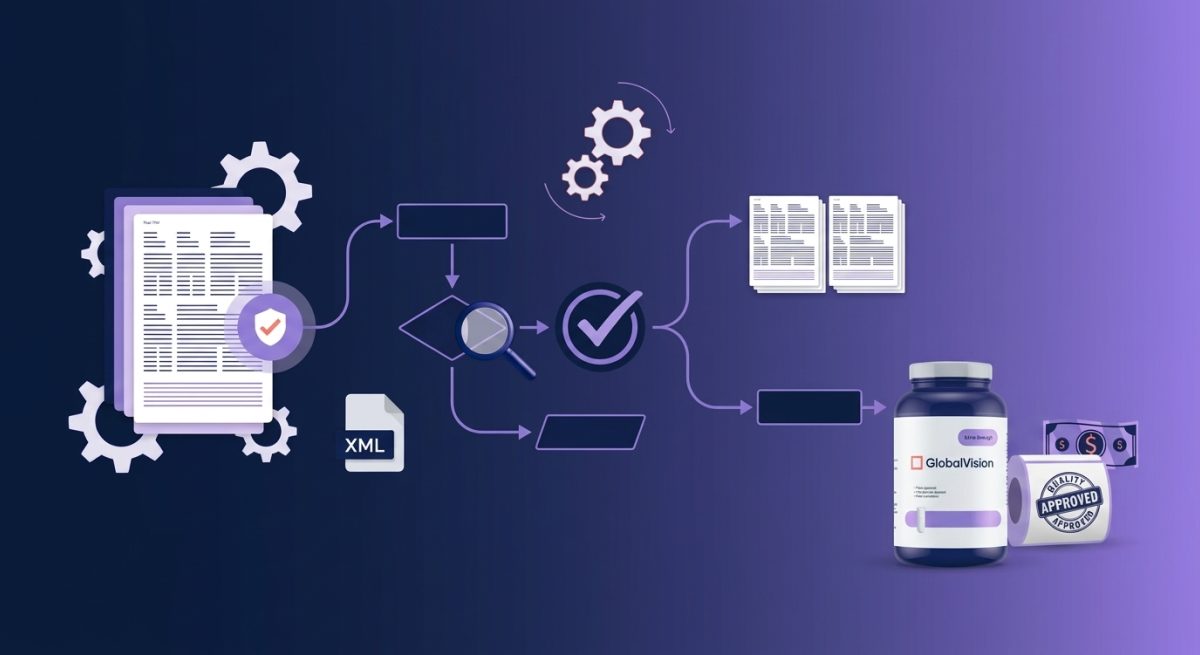


Most packaging errors don't announce themselves. They hide. They slip past a tired reviewer at 4 p.m., ride along on an outdated file, and surface only after thousands of units hit the line. By then, you're staring down a reprint, a delayed launch, or worse, a recall.
Here's the good news: those hidden causes are predictable. And once you know where they live, packaging automation gives your team a reliable way to shut them down before they cost you a dime.
In this post, we'll unpack what packaging automation is, expose the non-obvious sources of production errors, and show how automation attacks each one at the root.
What Is Packaging Automation?
Packaging automation uses software to handle the repetitive, error-prone tasks in your packaging workflow, so your team doesn't have to rely on outdated, manual efforts.
Instead of relying on manual proofreading, side-by-side file comparisons, and email chains to move artwork forward, automation does the checking for you. It inspects text, artwork, barcodes, braille, and color with a precision no human can sustain across hundreds of SKUs.
Think of it as a tireless quality checkpoint built into your process. It reviews every file, flags every discrepancy, and keeps production moving, without extra headcount and without slowing you down.
Key takeaway: Packaging automation replaces fragile manual checks with consistent, repeatable inspection that scales with your SKU count.
The Hidden Causes Behind Production Errors
Obvious errors are easy to blame. A typo here, a wrong barcode there. But the real culprits are systemic. They're baked into how manual workflows operate. Let's bring them into the light.
1. Human fatigue
Your team is sharp. But after reviewing 40 labels in a day, even the best eyes glaze over. Fatigue erodes accuracy, and the mistakes it causes are unpredictable. A missed decimal on a nutrition panel, a swapped allergen warning, a comma in the wrong place.
The problem? These errors are invisible until they're expensive. Manual proofreading simply can't hold the line hour after hour.
2. Manual handoffs
Every time a file passes from design to prepress to review to press, it changes hands. And every handoff is a chance for something to break. A layer gets dropped, a spec gets misread, a note gets lost.
The more markets and SKUs you manage, the more handoffs pile up. Each one adds risk you can't fully see.
3. Inconsistent file versions
Which file is the approved one? If your team hesitates for even a second, you've found a hidden error source. Version confusion sends outdated artwork to press, reintroduces mistakes that were already fixed, and quietly undermines batch-to-batch consistency.
In high-SKU environments with frequent label updates, version drift is one of the sneakiest and most costly problems around.
4. Communication gaps
Approvals scattered across email, chat, and sticky notes create blind spots. A last-minute copy change doesn't reach prepress. A regulatory update sits unread. A verbal "looks good" gets treated as a formal sign-off.
These gaps don't feel like errors, until they become one.
5. Regulatory blind spots
Compliance rules shift constantly across regions and languages. When your team tracks these changes manually, something inevitably slips. A missing warning, an outdated claim, or a mistranslated ingredient list can trigger a violation or force a recall.
Key takeaway: The biggest error sources aren't careless mistakes; they're systemic weaknesses in manual, fragmented workflows.
How Packaging Automation Fixes Each Root Cause
Now for the empowering part. Packaging automation doesn't just catch errors after they happen. It removes the conditions that create them. Here's how it addresses each hidden cause head-on.
Fixing Human Fatigue with Automated Inspection
Software never gets tired. It checks the 400th label with the same precision as the first.
Packaging automation runs automated proofreading on text, graphics, artwork, braille, and much more. It compares new artwork against an approved master and flags every deviation, no matter how small, no matter the hour.
- Catches misplaced decimals, swapped words, and formatting shifts in seconds
- Delivers consistent accuracy across long production days
- Frees your team to focus on judgment calls instead of line-by-line scanning
The result: fewer errors slip through, and your reviewers reclaim substantial time in their workday.
Eliminating Risky Handoffs with Integrated Workflows
Packaging automation plugs into the tools your team already uses, so files move through a connected pipeline instead of a series of manual passes.
For prepress teams, this means automation that integrates smoothly with platforms like Esko and CLOUDFLOW, embedding quality checks directly into the existing workflow rather than bolting on another disconnected step.
- Reduces the number of manual touchpoints where files break
- Standardizes checks at every stage, not just the final proof
- Keeps specs, layers, and formats intact from design to press
The result: smoother handoffs, fewer bottlenecks, and a workflow that holds together no matter how many SKUs you push through it.
Ending Version Confusion with Automated Comparison
Packaging automation anchors every check to an approved master file. New revisions are compared automatically against that reference, so outdated artwork can't sneak through.
- Confirms the right version reaches press every time
- Catches reintroduced errors that manual review misses
- Protects batch-to-batch consistency across runs and markets
The result: you stop shipping yesterday's mistakes and keep quality steady at scale.
The result: everyone works from the same source of truth, and last-minute changes stop turning into production errors.
Covering Regulatory Blind Spots with Built-in Verification
Packaging automation verifies compliance-critical elements, barcodes, braille, mandatory copy, and multi-language text, with consistency your manual process can't match.
- Verifies 1D and 2D codes so scans never fail at retail
- Inspects braille for accessibility compliance
- Checks copy across languages to support global regulatory standards
The result: you catch compliance risks before press, dramatically lowering the odds of a costly recall or violation.
Key takeaway: Packaging automation doesn't patch errors, it dismantles the systemic causes behind them.
The Real-World Impact on Errors and Team Efficiency
So what changes when you put packaging automation to work? The payoff shows up fast and compounds over time.
Fewer errors, fewer reprints
By catching discrepancies before files go to press, automation slashes reprint rates. Every reprint you avoid saves materials, labor, and press time, a direct win in high-volume environments where waste adds up quickly.
Faster time to market
Automated checks run in seconds instead of hours. Multiply the time saved across hundreds of SKUs and you reclaim entire days, getting products to shelf ahead of tight launch deadlines.
Consistent, scalable quality
Whether you're checking one file or ten thousand, automation applies the same standard every time. As your product line grows and you expand into new markets, quality stays locked in.
A more empowered team
When software handles the tedious inspection, your people focus on strategy, creativity, and the decisions that need a human. Morale climbs. Burnout drops. And trust in your output grows across every team that touches packaging.
Key takeaway: Packaging automation delivers measurable wins, fewer errors, faster launches, consistent quality, and a team freed to do its best work.
Getting Started with Packaging Automation
Ready to shut down hidden error sources? Keep this simple framework in mind:
- Map your workflow and pinpoint where fatigue, handoffs, and version confusion create the most risk.
- Prioritize high-impact checks, proofreading, barcodes, and compliance copy first.
- Integrate with your existing tools so adoption feels seamless, not disruptive.
- Standardize your checks across teams and sites for consistent quality everywhere.
- Track your results, reduced reprints, faster approvals, fewer errors, to prove ROI and refine as you grow.
Packaging Automation: The Bottom Line
The most damaging production errors aren't the ones you see coming. They're the hidden ones, born from fatigue, manual handoffs, version drift, and communication gaps. Packaging automation attacks every one of these at the root, replacing fragile manual processes with consistent, accurate, scalable inspection.
The outcome is a team that ships flawless packaging faster, avoids costly reprints and recalls, and stays confident no matter how high the SKU count climbs.
Start by mapping your current workflow and finding the one hidden error source costing you the most. That's your first, most valuable target for packaging automation, and the first step toward packaging you can trust every single time.
Frequently Asked Questions