

Flawless packaging doesn't happen by luck. It happens by design, by building a system that catches problems before they ever reach the press, the shelf, or the customer's hands. That system has a name: process control. And when it works hand in hand with quality assurance, it becomes the backbone of packaging you can trust, run after run.
For teams managing hundreds of SKUs, constant label updates, and launch deadlines that never seem to slow down, this pairing isn't optional. It's how you ship fast and flawless, without choosing between the two.
In this post, we'll break down what process control really means in packaging, how it connects to quality assurance, and how the two work together in modern production. You'll learn the role of standardization, inspection, real-time monitoring, and continuous improvement, plus how automation supercharges all of it.
What you'll take away:
- Clear definitions of process control and QA
- How the two work together in practice
- The role automation plays in strengthening both
- Best practices, common mistakes, and next steps
What Is Process Control in Packaging?
Process control is the practice of managing and monitoring every step of production to keep output consistent, accurate, and within defined standards.
Instead of hoping each run turns out right, process control builds guardrails into the workflow. It sets clear targets for what "good" looks like, measures against those targets in real time, and corrects course the moment something drifts. The goal is simple: produce the same high-quality result every single time, no matter the SKU count or the deadline.
Think of it as the steering system for your packaging pipeline. It keeps every file, every batch, and every run tracking toward the same standard, so you're never guessing whether this batch matches the last one.
Key takeaway: Process control keeps production consistent by setting standards, measuring against them, and correcting deviations before they become errors.
What Is Quality Assurance and How Is It Different?
Quality assurance (QA) is the broader framework that ensures your packaging meets defined quality and compliance standards from start to finish.
Here's the difference in plain terms:
- Process control focuses on keeping the production process stable and consistent as it runs.
- Quality assurance focuses on the overall system that guarantees the final product meets every requirement, accuracy, compliance, brand consistency, and safety.
Process control is one of the most powerful tools inside a strong QA framework. QA sets the standard; process control keeps production locked onto it. Together, they cover both the journey and the destination.
For CPG and prepress teams, this distinction matters. QA answers the question, "Does this meet our standards and regulations?" Process control answers, "Is our production consistently hitting those standards right now?" You need both to ship with confidence.
Key takeaway: QA defines and guarantees quality across the whole system; process control keeps production consistently on target. One sets the goal; the other keeps you on course.
How Process Control and QA Work Together
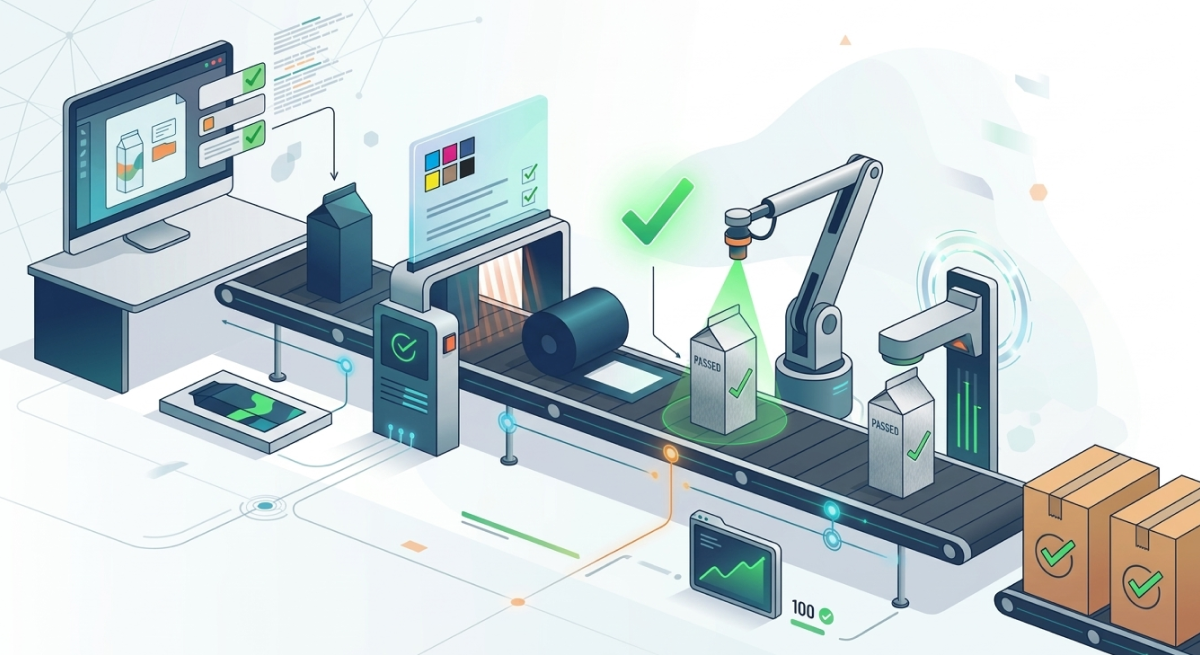
Modern packaging runs on the tight partnership between these two. Let's walk through the five ways they connect in a real production environment.
1. Standardization: the shared foundation
Everything starts with clear, documented standards. What are the exact specs for this label? The approved color values? The mandatory copy for each market? Standardization defines "correct" so there's no ambiguity anywhere in the workflow.
Without standards, process control has nothing to measure against and QA has nothing to verify. With them, every team, design, prepress, production, works from the same source of truth.
- Establishes one approved master reference for every file
- Removes subjective judgment from quality decisions
- Keeps output consistent across teams, sites, and markets
In high-SKU environments, standardization is what makes scale possible. It turns "we think this looks right" into "this matches the approved standard, precisely."
2. Inspection: verifying against the standard
Inspection is where standards get enforced. It's the systematic checking of files and output against approved references, text, artwork, barcodes, braille, and color.
Manual inspection works at small scale. But when you're reviewing the 400th label of the day, tired eyes miss things, a shifted decimal on a nutrition panel, a swapped allergen warning, a barcode that won't scan at checkout. That's exactly where errors slip through and QA breaks down.
The fix is consistent, repeatable inspection that never fatigues. More on that when we get to automation.
3. Real-time monitoring: catching drift as it happens
Process control shines when it monitors production live. Real-time monitoring tracks output against your standards continuously, so deviations get flagged the moment they appear, not after a full run has printed.
Imagine color gradually drifting across a long press run. Real-time monitoring catches that drift early, before it produces thousands of off-brand units. That's the difference between a quick correction and a full, costly reprint.
- Detects deviations as production runs
- Prevents small drifts from becoming large-scale defects
- Keeps every batch matching the approved standard
4. Error detection: stopping defects before they spread
Error detection is the heartbeat of both process control and QA. The earlier you catch a defect, the cheaper it is to fix, and the less damage it does downstream.
A mistake caught in prepress costs minutes. The same mistake caught after printing costs an entire run. Caught after distribution? It can trigger a recall. Strong error detection compresses that risk, catching discrepancies while they're still cheap and easy to resolve.
5. Continuous improvement: closing the loop
The best packaging operations don't just catch errors, they learn from them. Continuous improvement uses data from inspections and monitoring to spot patterns, refine standards, and strengthen the process over time.
When the same error keeps appearing, that's a signal. Maybe a file intake step needs tightening. Maybe a color profile needs updating. Continuous improvement turns every caught error into a smarter, more reliable process going forward.
Key takeaway: Standardization, inspection, real-time monitoring, error detection, and continuous improvement form the loop where process control and QA reinforce each other.
How Automation Strengthens Process Control and QA
Here's where modern packaging pulls ahead. Manual process control and QA are precise, but they carry built-in limits, human fatigue, inconsistent handoffs, and version confusion. Automation removes those weak points, not by replacing your expertise, but by handling the repetitive checks that drain time and invite mistakes.
Let's look at where automation makes the biggest difference.
Consistent inspection that never tires
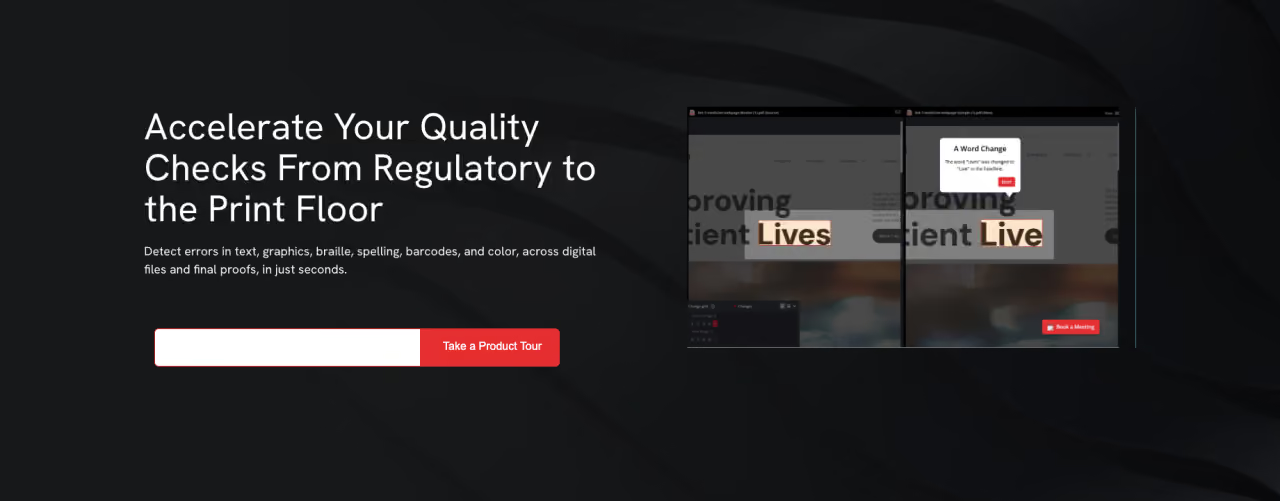
Automated inspection checks the 400th file with the same precision as the first. It compares every file against an approved master and flags every deviation, text, artwork, color, barcode, or braille, in seconds.
The payoff is real and measurable: reviewers reclaim substantial time on every label. Multiply that across hundreds of SKUs and you've reclaimed entire days.
Early error detection that protects your budget
By catching discrepancies before files reach the press, automation slashes reprint rates. Every reprint you avoid saves materials, labor, and press time, a direct win in high-volume environments where waste adds up fast. And by verifying compliance-critical elements early, it dramatically lowers the odds of a costly recall or regulatory violation.
Standardized quality across every team and site
Automation applies the exact same checks the exact same way, everywhere. Whether you're inspecting one file or ten thousand, across one site or a dozen markets, quality stays locked in. That's process control and QA operating at true scale.
Integration with the tools you already use
The strongest automation strengthens your existing workflow instead of replacing it. The best solutions integrate directly with the prepress platforms your team already relies on. That means quality checks embed right into your current process, no rebuild, no disruption, just smoother handoffs, faster turnaround, and consistent output.
Key takeaway: Automation reduces human error, catches defects early, and standardizes quality at scale, turning process control and QA from fragile manual efforts into reliable, repeatable systems.
Best Practices for Strong Process Control and QA
Ready to tighten both? These practices deliver the biggest gains for fast-paced, high-SKU teams.
- Define clear standards first. Establish approved master files, exact color values, and mandatory copy for every market. You can't control what you haven't defined.
- Anchor every check to the approved master. Comparing revisions against a verified reference ends version confusion and stops outdated artwork from reaching press.
- Inspect early and often. Build checks into every stage, intake, revision, proofing, not just the final proof. Early detection is cheap detection.
- Automate high-risk checks first. Prioritize proofreading, color, barcodes, and compliance copy, the errors that cost the most when missed.
- Enable real-time alerts. Catch deviations as they happen so corrections stay small and fast.
- Integrate, don't isolate. Embed automation into your existing prepress platforms so adoption feels seamless and quality stays consistent company-wide.
- Track and refine. Measure reprints, error rates, and turnaround times. Use the data to close the loop and keep improving.
Common Mistakes to Avoid
Even strong operations stumble on these. Watch for them:
- Treating QA as a final checkpoint. Quality checked only at the end lets errors travel, and multiply, all the way downstream. Embed checks throughout.
- Relying solely on manual inspection. Human eyes are essential for judgment calls, but they can't sustain flawless accuracy across hundreds of SKUs. Let automation handle the repetitive checks.
- Skipping standardization. Without a single approved reference, every review becomes subjective, and inconsistency creeps in.
- Ignoring version control. Sending an outdated file to press reintroduces mistakes you already fixed. Anchor everything to the master.
- Setting it and forgetting it. Process control isn't one-and-done. Without continuous improvement, small problems quietly become recurring ones.
Avoid these, and your process control and QA will actually hold up under pressure.
Key takeaway: The biggest failures come from checking quality too late, leaning only on manual review, and skipping standardization. Build quality in from the start.
Process Control: The Bottom Line
Process control and quality assurance are the twin engines of modern packaging. Process control keeps production consistently on target; QA guarantees the final product meets every standard for accuracy, compliance, and brand consistency. Together, powered by standardization, inspection, real-time monitoring, error detection, and continuous improvement, they turn "we hope it's right" into "we know it's right."
Automation takes both to the next level. By handling repetitive checks with tireless precision, catching defects early, and standardizing quality across every SKU and site, it delivers faster launches, fewer reprints, confident compliance, and consistent output at scale. And when it integrates directly with the prepress tools you already use, you gain all of that without disrupting your workflow.
Start by defining your standards and anchoring every check to an approved master. Then automate your highest-risk inspections and turn on real-time alerts. That's your highest-value first move, and your first step toward packaging quality you can trust, every single run.
Ready to build process control and QA that scale as fast as you do? Map your workflow, find the checks costing you the most, and put automation to work where it matters most.
Frequently Asked Questions