

A single misplaced decimal on a dosage line. A warning statement that didn't make it onto the carton. A barcode that won't scan at the pharmacy counter. In most industries, these are nuisances. In pharma, they're the difference between a safe product and a recall that puts patients at risk.
Pharmaceutical packaging carries more regulatory weight than almost any other product category on the planet. Every element, from the drug name to the braille on the carton, exists because a regulator requires it and a patient depends on it. For print, packaging, and prepress teams, that means accuracy isn't a goal. It's the baseline.
Here's what you'll take away from this guide:
- Why pharmaceutical packaging is uniquely regulated and what that demands of your team
- The key compliance requirements set by the FDA, EMA, and other global bodies
- The mandatory content elements every pharma label and carton must carry
- Tamper-evidence and child-resistant standards you can't skip
- How prepress quality control protects compliance before the press runs
- The real cost of non-compliance, and how to stay audit-ready at scale
What Makes Pharmaceutical Packaging Uniquely Regulated
Pharmaceutical packaging isn't just a container, it's a regulated medical communication tool. The carton, label, leaflet, and foil all carry information that clinicians and patients rely on to dose safely, store correctly, and avoid harm. That's why regulators scrutinize every detail.
Three pressures make pharma packaging different from any other category:
- Patient safety is on the line. A labeling error can lead to a wrong dose, a missed warning, or a dangerous drug interaction.
- The rules never stop evolving. Serialization mandates, regional language laws, and updated warning requirements change constantly across markets.
- The volume is relentless. A single drug can ship across dozens of countries, each with its own labeling, language, and formatting rules.
For high-SKU operations launching across global markets, this creates a steep challenge: maintain flawless accuracy while moving fast enough to hit launch dates. Get the balance right, and you protect both patients and your bottom line.
That's the stakes. Now let's look at the rules.
Key Compliance Requirements: FDA, EMA, and Beyond
Pharmaceutical packaging answers to a web of regulators, each with its own standards. While specifics vary by region, the core expectation is universal: the packaging must be accurate, traceable, and verifiable against an approved master.
Here's how the major bodies shape requirements:
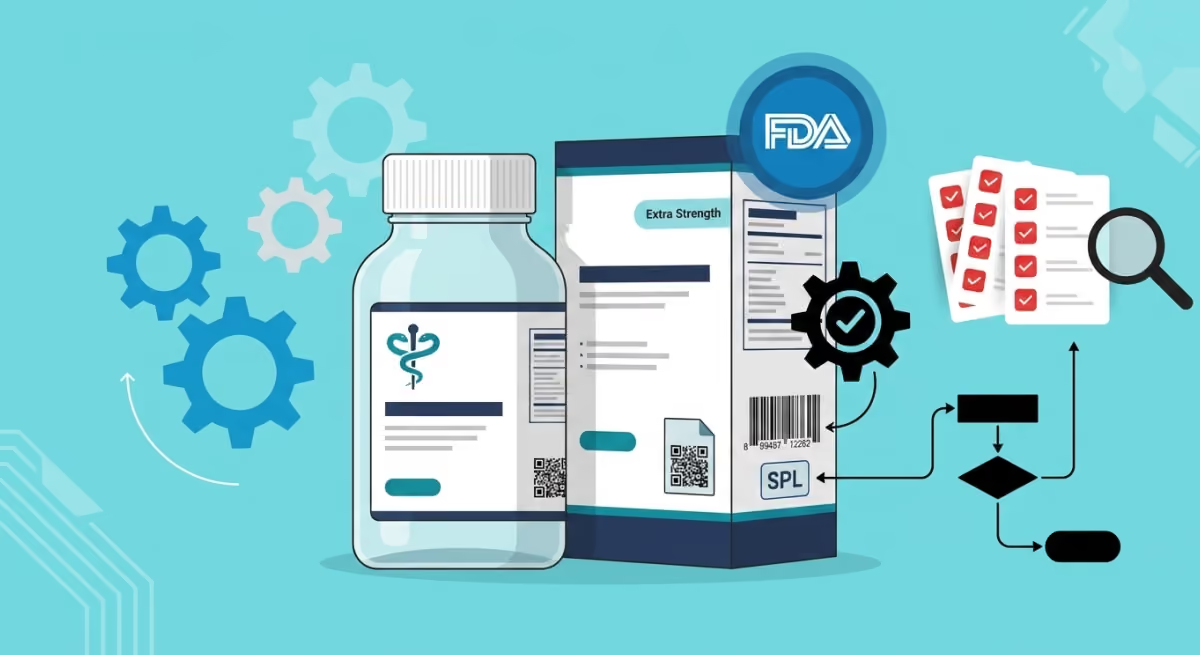
- FDA (United States): Enforces Structured Product Labeling (SPL) in XML format, the Drug Supply Chain Security Act (DSCSA) for serialization, and strict rules on content and format under 21 CFR.
- EMA (European Union): Governs labeling under EU directives, mandates braille on cartons, requires the Falsified Medicines Directive (FMD) for serialization, and enforces multi-language packaging across member states.
- MHRA (United Kingdom): Applies UK-specific labeling and serialization rules post-Brexit, often requiring distinct packaging from EU markets.
- Other global bodies: Health Canada, TGA (Australia), PMDA (Japan), and others each add regional language, format, and safety requirements.
The pattern is clear: every market you enter adds another layer of rules, and another opportunity for error. Tracking those layers manually across a growing SKU portfolio is where teams get overwhelmed.
The smart move is to verify every version against an approved standard before it ever reaches the press.
Mandatory Label and Packaging Content Elements
Regulators don't leave content to interpretation. Pharmaceutical packaging must carry specific, precisely formatted elements, and each one is a potential failure point if it's wrong.
Core content every pharma package must include
- Drug name and strength: The exact proprietary and generic names, plus the precise dosage strength.
- Dosage and administration: Clear instructions for use, formatted to regulatory standards.
- Warnings and contraindications: Boxed warnings, allergen statements, and safety information.
- Serialization codes: Unique identifiers (such as 2D Data Matrix codes) for track-and-trace compliance under DSCSA and FMD.
- Expiration and batch data: Expiry dates, lot numbers, and manufacturing dates in approved formats.
- Unique Device Identifiers (UDI): Required for combination products and drug-device packaging.
- Braille: Mandatory on EU cartons for the medicine name and strength.
- Regulatory symbols and statements: Required icons, storage conditions, and legal text.
Why each element carries risk
Every item on that list must match the approved master exactly. A transposed digit in a batch code breaks traceability. A missing allergen warning becomes a safety hazard. A barcode that fails to decode stops the product at distribution.
In short: there are no minor elements in pharmaceutical packaging. Each detail is a compliance checkpoint, and each one deserves verification before print.
Tamper-Evidence and Child-Resistant Packaging Standards
Beyond what's printed, regulators dictate how pharmaceutical packaging physically protects the product and the people who use it. Two standards stand out.
Tamper-evident packaging
Tamper-evident features, shrink bands, sealed cartons, breakaway caps, give clear visual proof if a package has been opened or compromised. In the US, the FDA mandates these features for many over-the-counter products. The packaging must show obvious evidence of any breach, protecting patients from contamination or product interference.
Child-resistant packaging
Child-resistant (CR) packaging is designed to be difficult for young children to open while remaining accessible to adults. In the US, the Poison Prevention Packaging Act sets these standards; similar rules apply across the EU and other markets. Blister packs, push-and-turn caps, and peel-push designs all serve this purpose.
For packaging teams, these standards add design and structural requirements on top of the content rules, and both must be verified together. A compliant label on a non-compliant structure still fails the audit.
Artwork and Prepress Quality Control for Pharma
Here's a truth every prepress professional knows by heart: the press faithfully reproduces whatever you give it, including the errors. If a mistake survives prepress, it survives all the way to the pharmacy shelf, multiplied across every unit in the run.
That's why quality control belongs upstream, embedded in prepress, long before plates are made or files hit the press.
Why manual review can't keep up
Manual proofreading has served pharma for decades, but it strains under modern demands:
- Fatigue causes oversights. Tired eyes miss subtle character swaps, spacing shifts, and color deviations.
- Volume overwhelms reviewers. High SKU counts and frequent label updates outpace manual checks.
- Language barriers create blind spots. Verifying multi-market labels in unfamiliar languages is nearly impossible by eye.
- Results stay inconsistent. Two reviewers can reach two different conclusions on the same file.
How automated proofreading protects compliance
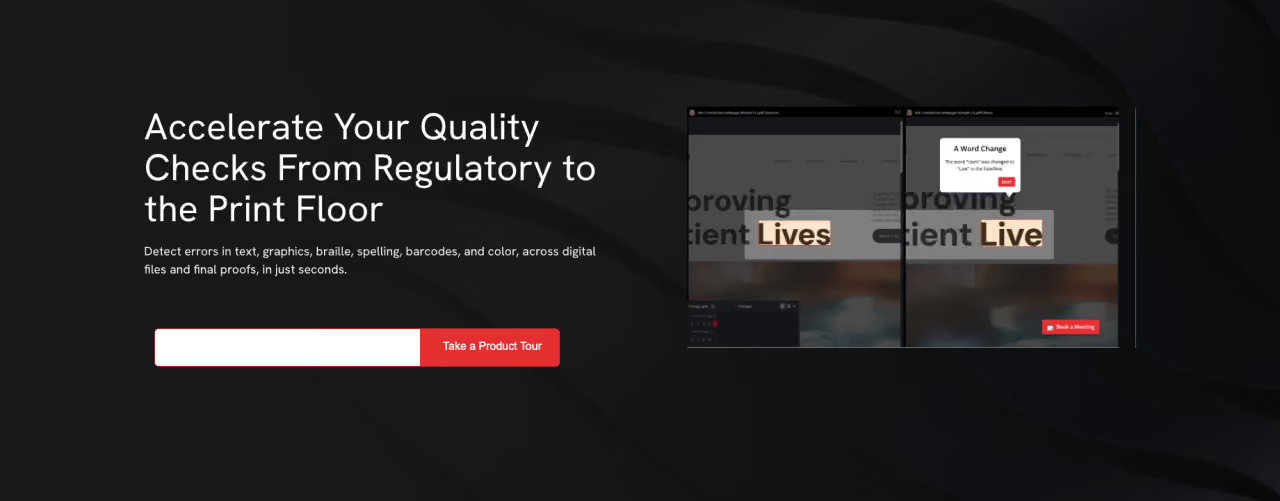
Automated proofreading inspects every file against an approved master and flags deviations the eye misses. Built into prepress, it verifies accuracy before you commit to platemaking. The most valuable checks include:
- Text and spelling verification across every language version
- Graphics and artwork comparison against the approved master
- Barcode and serialization code integrity to confirm every code scans and decodes
- Braille inspection for EU carton compliance
- Color and registration checks against brand and regulatory standards
By standardizing inspection, automated proofreading gives every file the same rigorous, repeatable check, no fatigue, no guesswork, no bottleneck. That's exactly what pharmaceutical packaging demands.
The Cost of Non-Compliance in Pharmaceutical Packaging
It's tempting to treat a packaging error as a minor fix. In pharma, the math tells a very different story. One mistake that reaches the market sets off a chain reaction across safety, finance, and reputation.
The takeaway across every row is the same: a packaging error is never cheap. Mislabeling consistently ranks among the leading causes of pharmaceutical recalls, and it's one of the most preventable. Catching the error in prepress costs a fraction of catching it on the shelf.
Best Practices for Staying Audit-Ready
Audit-readiness isn't a scramble before the inspector arrives, it's a workflow you build once and rely on every day. Here's how leading pharma packaging teams stay ready.
1. Establish a single source of truth
Lock in one approved master file for every package. Every inspection compares against this master, eliminating any ambiguity about what "correct" looks like.
2. Embed automated proofreading early
Catch errors in prepress, not on press. Run automated inspections the moment artwork arrives and again after every revision. The earlier you catch a deviation, the cheaper and faster the fix.
3. Verify every language and market version
Treat each regional version as its own file requiring full verification. Automated text comparison makes multi-language checks fast and reliable, even in languages your team doesn't read.
4. Build inspection into approval gates
Make a passed automated inspection a required step before any file advances to platemaking. This turns quality control into a non-negotiable gate, not an optional courtesy.
5. Maintain a complete audit trail
Log every inspection, revision, and approval. When regulators come knocking, and in pharma, they will, you'll have documented proof that every package met spec before it was printed.
Put these practices together, and compliance stops being a source of stress. It becomes a built-in, repeatable strength that scales right alongside your SKU count and global reach.
Ensure Your Pharmaceutical Packaging is Always Compliant
Pharmaceutical packaging leaves no room for "good enough."
Every character, code, color, and structural feature either meets the standard or it doesn't, and the consequences of getting it wrong are too serious to leave to chance. The teams that thrive are the ones that engineer accuracy into their prepress workflow, lean on automated proofreading to eliminate manual blind spots, and treat every inspection as a gate rather than a guess.
Do that, and you achieve the rare combination pharma demands: flawless, audit-ready packaging delivered at full speed across every market you serve.
Frequently Asked Questions