📺 Webinar in diretta | 2 dicembre: Abbiamo creato un controllo qualità migliore. Lasciate che ve lo dimostriamo. Registratevi ora.

Regulatory Compliance Explained: What It Really Takes to Stay Legally Aligned in 2026

Regulatory compliance in 2026 means knowing which rules apply, building controls that meet them and proving it at any moment.
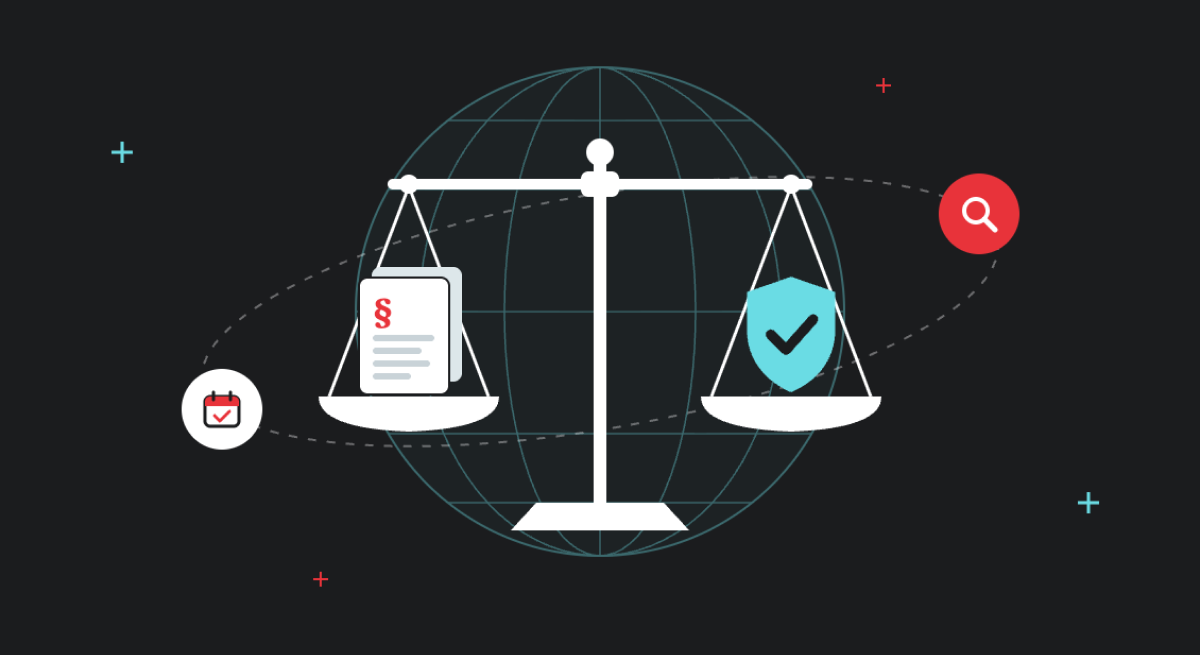
White scales of justice in front of a globe outline, with a document symbol on the left scale and a blue shield with a checkmark on the right scale, representing regulatory compliance and security.
Aggiornato Il:
novembre 27, 2026
Categoria:
Conformità
Autore:
Hana Trokic

TL;DR

Regulatory Compliance: Key Takeaways
‍

  • Define It: Regulatory compliance means following applicable laws and regulations and proving it with documented evidence.
  • Know the Cost: Non-compliance costs 2.71 times more than maintaining compliance, according to Ponemon research.
  • Track 2026 Changes: The EU AI Act, Omnibus I and FDA QMSR all reshaped compliance deadlines this year.
  • Build the Program: Strong programs combine obligation mapping, ownership, risk assessment, controls, documents, training and monitoring.
  • Stay Ready: Continuous monitoring and automation keep evidence current, so inspections bring no surprises.
    ‍

Regulatory compliance is how an organization follows the laws, regulations and standards that apply to it, and proves it with documented evidence. It matters because non-compliance brings fines, recalls, blocked market access and lost trust. It affects every regulated business, especially pharmaceutical, medical device, life sciences and financial companies, and any firm that handles personal data.


‍

‍

What is Regulatory Compliance?

‍

Regulatory compliance is the process of making sure an organization follows the laws, regulations, standards and government guidelines that apply to its industry, products and locations, and being able to prove it. It covers data protection, financial reporting, product safety, labeling, workplace health and environmental rules.

‍

The proof matters as much as the practice. Regulators and inspectors expect documented evidence: policies, training records, controls, audit trails and corrective actions.

‍

Compliance is also harder in 2026 than it was three years ago. Rules change faster, deadlines shift mid-project, and enforcement now reaches AI systems, supply chains and cyber resilience.


‍

‍

Why Does Regulatory Compliance Matter More in 2026?

‍

Non-compliance costs far more than compliance. A Ponemon Institute and Globalscape study found that non-compliance costs 2.71 times more than maintaining compliance, once disruption, lost productivity, fines and settlements are counted. It remains one of the most cited benchmarks on the cost of compliance.

‍

Fines are only the visible part. The larger costs usually come from:

‍

  • Business disruption: halted production, frozen launches or suspended licences.
  • Remediation: emergency consultants, legal fees and rebuilt processes.
  • Market access: warning letters, import alerts or failed inspections that block sales.
  • Reputation: lost customer and investor trust.
  • Personal liability: rules such as DORA and NIS2 hold senior management accountable.

‍

‍

Reactive vs. Proactive Compliance

‍

  Reactive compliance Proactive compliance
When gaps are found During audits or after incidents Through ongoing monitoring
Evidence Assembled before inspections Captured as work happens
Regulatory change Handled after the effective date Assessed and planned in advance
Cost profile Fines, disruption, emergency fixes Predictable program costs
Inspection outcome Findings and corrective actions Fewer findings, faster closure


Fewer findings, faster closure

‍

Three trends make 2026 different:

‍

  1. Moving deadlines. The EU has reshaped major laws mid-implementation through "omnibus" packages.
  1. Broader scope. Regulation now covers AI systems, ICT providers and cyber resilience.
  1. Evidence over intent. Inspectors expect live, traceable records, not binders prepared the week before.

‍

‍

Which Regulations Shape Regulatory Compliance in 2026?

‍

The rules that apply depend on your industry and markets. These six are reshaping compliance programs across sectors this year.

‍

Regulation Who it affects 2026 status
EU AI Act (Regulation 2024/1689) Providers and deployers of AI systems in the EU The Digital Omnibus on AI moved stand-alone high-risk obligations to 2 Dec 2027 and product-embedded ones to 2 Aug 2028; transparency rules stay on schedule
CSRD and CSDDD, amended by Directive (EU) 2026/470 Large EU and non-EU companies CSRD narrowed to companies with 1,000+ employees and EUR 450m+ turnover; in force since 18 Mar 2026
FDA QMSR (21 CFR Part 820) Medical device makers selling in the US Effective 2 Feb 2026; incorporates ISO 13485:2016 and replaces the QSIT inspection model
DORA (Regulation 2022/2554) EU financial entities and their ICT providers Applies since 17 Jan 2025; focus now on resilience testing and third-party oversight
NIS2 Directive Essential and important entities in 18 EU sectors National enforcement continues; management bodies carry personal accountability
GDPR Anyone processing EU residents' personal data Still the data protection baseline; fines up to EUR 20m or 4% of global turnover

‍

Takeaway: a delay is not a pause. Regulators expect preparation to continue, and parts of each law often stay on the original timeline.


‍

‍

What Are the Core Parts of a Regulatory Compliance Program?

‍

An effective compliance program has seven connected parts. Miss one and the others weaken.

‍

  1. Regulatory inventory. A living register of every law, regulation and standard that applies, mapped to the processes it touches.
  1. Governance and ownership. Named owners for each obligation and board-level oversight. Learn how teams set this up in our guide to compliance management.
  1. Risk assessment. A structured review of where you are most exposed, ranked by likelihood and impact. See how to run a compliance risk assessment.
  1. Policies, procedures and controls. Written rules that turn legal requirements into daily tasks, backed by controls that prevent or detect failures.
  1. Document control and records. Version-controlled SOPs, approvals and audit trails. Read more on document control in regulated industries.
  1. Training and culture. Role-based training with records, and a culture where people raise issues early.
  1. Monitoring, auditing and corrective action. Ongoing checks, internal audits and CAPA that fixes root causes. Explore continuous compliance monitoring.

‍

Together, these parts turn regulatory compliance from a one-off project into an ongoing capability.


‍

‍

How Do You Stay Compliant? 8 Steps

‍

Staying compliant is a cycle, not a finish line. These eight steps give most organizations a working compliance framework.

‍

  1. Identify every applicable regulation. List the markets you sell in, your products and the data you handle. Include standards customers require, such as ISO 27001 or ISO 13485.
  1. Map obligations to processes. Break each regulation into specific compliance requirements, each with a process, system and owner.
  1. Run a gap assessment. Compare current practice with each requirement. Fix the highest-risk gaps first.
  1. Write and control policies and SOPs. Turn requirements into clear procedures under version control and approval workflows.
  1. Build and test controls. Add preventive controls (approvals, access limits, validation) and detective controls (reviews, alerts). Test that they work.
  1. Train people by role. Tie training to job roles and record completion and effectiveness.
  1. Monitor and audit. Use dashboards and compliance automation between internal audits so problems surface in days, not at the next inspection.
  1. Track regulatory change. Assess each new or amended rule for impact and update controls before the effective date.

‍

Pro tip: treat every finding as data. Trends in deviations, CAPAs and audit findings show where your next compliance risk is forming.


‍

‍

What Are the Biggest Regulatory Compliance Challenges?

‍

Challenge What it looks like How leading teams fix it
Regulatory overload Too many rules across too many markets to track by hand Central obligations register, regulatory change feeds, clear owners
Siloed compliance Quality, legal, IT and finance each run separate programs One shared framework, common risk scoring, joint reporting
Spreadsheet sprawl Evidence scattered across email, drives and personal files Controlled document management with audit trails
Audit-week scramble Records assembled only before an inspection Inspection-ready processes and continuous monitoring
Third-party blind spots Suppliers and IT vendors outside your controls Vendor risk assessments, contracts with audit rights, ongoing monitoring
Moving deadlines Laws amended mid-implementation Track official journals and adopt the stricter timeline until changes are final
Manual effort Compliance staff spend most time collecting evidence Compliance automation for evidence collection, reminders and reporting

‍

‍

How is Regulatory Compliance Different from Compliance Management and Risk Management?

‍

These terms overlap but mean different things.

‍

Term Core question Focus Output
Regulatory compliance Are we meeting the law? External laws and regulations Evidence of conformance
Compliance management How do we organize and run compliance? Governance, processes, people, tools A working compliance program
Compliance risk management Where could we fail, and how do we prevent it? Likelihood and impact of non-compliance Prioritized controls and mitigation

‍

Regulatory compliance is the goal. Compliance management is the system that delivers it. Compliance risk management decides where to focus first.


‍

‍

Conclusion: Compliance is a Capability, not a Checkbox

‍

Regulatory compliance in 2026 means knowing which rules apply, building controls that meet them and proving it at any moment. Teams that do this well run it continuously: mapped obligations, owned controls, controlled documents and live monitoring.

‍

To see how these pieces fit into one operating model, read our complete guide to regulatory compliance management.


‍

‍

Regulatory compliance FAQs

‍

What is regulatory compliance in simple terms?
Regulatory compliance means following the laws and rules that apply to your business and keeping proof that you do. It applies to areas such as data privacy, product safety, finance, employment and the environment.
What are examples of regulatory compliance?
Common examples include GDPR for personal data, FDA GMP and QMSR rules for drug and device makers, DORA for EU financial firms, SOX for US public company reporting, and OSHA for workplace safety.
Who is responsible for regulatory compliance?
The board and senior management are ultimately accountable. A compliance officer or team usually runs the program, while every process owner is responsible for compliance within their own area.
What happens if a company is non-compliant?
Consequences include fines, warning letters, product recalls, licence suspension, lawsuits and reputational damage. Under laws like NIS2 and DORA, individual managers can also face personal consequences.
How often should compliance be reviewed?
Continuously. Most organizations run formal risk assessments and internal audits at least once a year, with ongoing monitoring between them and immediate review whenever a regulation changes.
What is the difference between regulatory compliance and corporate compliance?
Regulatory compliance covers external laws and regulations. Corporate compliance is broader and also includes internal policies, codes of conduct and ethics standards the company sets for itself.
Can regulatory compliance be automated?
Partly. Software can automate evidence collection, document control, training tracking, alerts and reporting. Human judgment is still needed to interpret regulations, assess risk and make decisions.

‍

Webpage with text about accelerating quality checks and a product tour button on a dark background.

‍