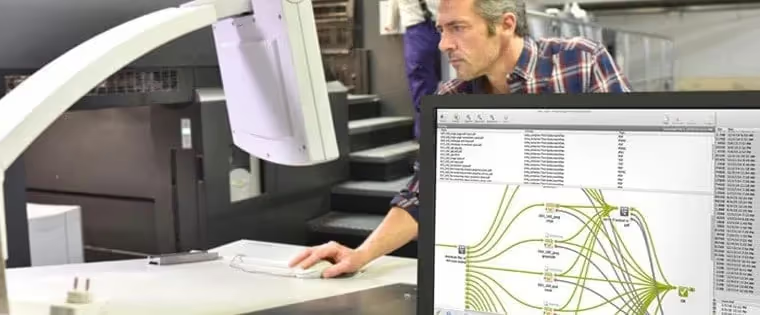


When flipping through a brochure or any sort of packaging, you probably think that to get a design printed all you have to do is press the print button. The truth is there are plenty of steps in between before that design becomes ink on paper. One or more of these steps most likely involved prepress software.
Prepress and Reprographics are vital elements in any quality control process, and, like the packaging industry itself, they’re constantly changing and redefining the way we do our jobs. Over the years, companies’ demands for production have continued to increase to market their products. So, it’s no surprise the worldwide printing market has become a $5-billion industry. With such high stakes, quality work is critical, which means prepress houses must stay in the loop with current technology.
With the advent of desktop computers decades ago, what we used to call prepress and repro departments are now quickly transforming into completely different things.
The process has changed dramatically, from mechanical board systems, paste-ups, and conventional cameras to all-in-one automated workflows. Now, prepress professionals have to be multi-talented; It’s no longer just about the plate.
Historic Review of Prepress Printing
Traditional prepress methods consisted of several, time-consuming steps and were often prone to errors. The process began with the design of rough sketches that would then go to a typesetter for text inclusion. Typesetting was done on obsolete metal types or type composition machines, such as Linotype. Images were photographed and edited using conventional photographic procedures. Text and images then go to the paste-up person who adds everything on a paste-up board.
After all the text and "For Position Only" boxes for images are placed, the paste-up board is photographed and negatives are created. The "stripper" takes these negatives, checks them, and then brings everything together into flats or sheets. These flats are ”imposed” in the order set to be printed, according to how they’ll be cut, folded, or assembled.
Finally, the imposed pages are turned into plates for manual proofreading and later go in the printing press.
It was a long and highly technical process that involved a lot of manual operation, subsequently creating a larger risk for error. Turnaround times were longer, and, even if humans are taken out of the equation, these types of printers usually dealt with image alignment and coloring issues, so predictability was out of the question too.
Modern Prepress Technology
The packaging industry is completely controlled by customers’ needs – that driving force of change whose expectations will always exceed reality.
If you offer prepress solutions, you’re probably used to being given near-impossible tasks to be done in the smallest amount of time. Clients want their products to stand out from the crowd and it’s your job to deliver as soon as possible.
With that being said, how do we keep doing that in a world where needs and demands are always changing? We change the way we’re doing things.
We evolve in order to surpass our challenges and achieve the ultimate goal: getting the job done faster, better, and in the most cost-effective way, which leads to our main focus: How did prepress evolve into the digital and automated world?
Most importantly, how did this change influence the packaging industry?
With the advent of digital printing, market dynamics promptly shifted away from plates to more conventional printing technologies, such as offset and flexography.
Desktop publishing stopped being a trend and became a reality for businesses. However, it’s surprising to know that, even today, a considerable share of the global prepress packaging market still uses tooling and plate manufacturing.
Desktop Publishing Process
Modern desktop publishing begins at the designing stage, but this time, designers make early digital sketches with which they have complete control over the type, changing it on the fly, arranging it right on the page, adjusting leading, kerning, and tracking without needing a typesetter or a paste-up person. The same goes for images; They can be digitally cropped, scaled, and color-enhanced.
Designers then place everything on the publication and rearrange it as necessary. In the event these files need imposition, this is also done completely within the software used for publication. Regarding proofreading and quality control, even manual proofreading is easier using desktop publishing compared to traditional methods – mainly because it gives you the chance of printing interim copies on regular printers, so lots of errors are caught before the publication reaches the negatives or plating stages.
Another benefit of digital prepress printing is that you can output directly to film, from the digital file, or directly from the digital file to the plate. This shift from analog to digital is making film-based engraving disappear from the market. Even big players like Fuji and Kodak have stopped fabricating film plotters, so it’s only a matter of time before the whole industry makes this switch.
Key Perks of Prepress Software
Quality
Digital printing offers far better results when it comes to quality. Images are basically flawless, there are no alignment or registration issues, and the color turns out to be vibrant, making repeated images 100% predictable. These printers can also use the entire length of a printable item.
Low Cost
While it might seem too expensive to invest in, eventually you’ll end up cutting costs. Conventional printers rely on plates and films, which can be quite pricy. Digital printing doesn’t use these materials and they’re very easy to set up and operate.
Speed
Turnaround times are reduced drastically and digital printers can switch over to new labels almost immediately. You won’t waste time setting up plates or machinery parts, reaching job completion deadlines days or even weeks earlier.
Low Risk
By reducing manual operation, the possibility of human error, possibly leading to a complete product recall, is reduced to a minimum. It also means personnel can be deployed to complete other productive tasks.
Automated Prepress Workflows
Workflow is a fairly generic term used to refer to the steps a job or project must go through in order to be completed. In the prepress business though, a workflow doesn’t refer to the process, but to the software that automates all these steps of the process. Workflows integrate all the decisions and deliverables required from the early design stages all the way through to printing.
Workflow automation is a concept that is probably easier to understand than it is to define. It incorporates a wide set of tools (within each workflow segment) intended to help users boost their efficiency, lower costs, and minimize the impact of human error, resulting in a faster time to market.
Current prepress workflows, like Esko’s Automation Engine, run through all the basic production steps, like trapping, screening, imposition, color management, proofreading, and plate making. Yet Esko’s engine differs from conventional software because it’s tailored for the packaging industry. It features several functions that correspond to the complexity of the end product: folding cartons, corrugated boxes, bags, labels, and more.
These types of automated workflows also reflect the wide array of inks, shapes, substrates, and finishes needed in the industry to increase shelf appeal, proving automation is a valuable asset for businesses.
Color Management Software
Color management is a key step of the printing process, especially when it comes to packaging. Como as tintas não são completamente opacas, a cor, textura e densidade do material de embalagem aparecerão por baixo da tinta impressa, resultando em uma variação de cor que pode ser substancial. É por isso que os profissionais de pré-impressão devem levar todos esses fatores em consideração para criar o melhor resultado possível para os clientes.
A melhor forma de controlar a cor é medi-la usando um espectrodensitômetro, mas isso significaria uma carga extra de trabalho para os profissionais de pré-impressão. O que estamos vendo no mercado atual é que os clientes estão transmitindo especificações de cor digitalmente, por valores espectrais, para que softwares de gerenciamento de cores atuais, como o Color Engine da Esko, possam comparar esses valores com bibliotecas de cores digitais.
Uma das bibliotecas mais bem-sucedidas é a PantoneLIVE. É um banco de dados espectral centralizado baseado em nuvem que permite que proprietários de marcas, designers, profissionais de pré-impressão e, na verdade, qualquer pessoa na cadeia de suprimentos, atendam às especificações e tolerâncias de cor, ao mesmo tempo em que garante que todos os arquivos enviados para a sala de impressão serão impressos com problemas mínimos de cor.
Controles de Qualidade Tudo-em-Um
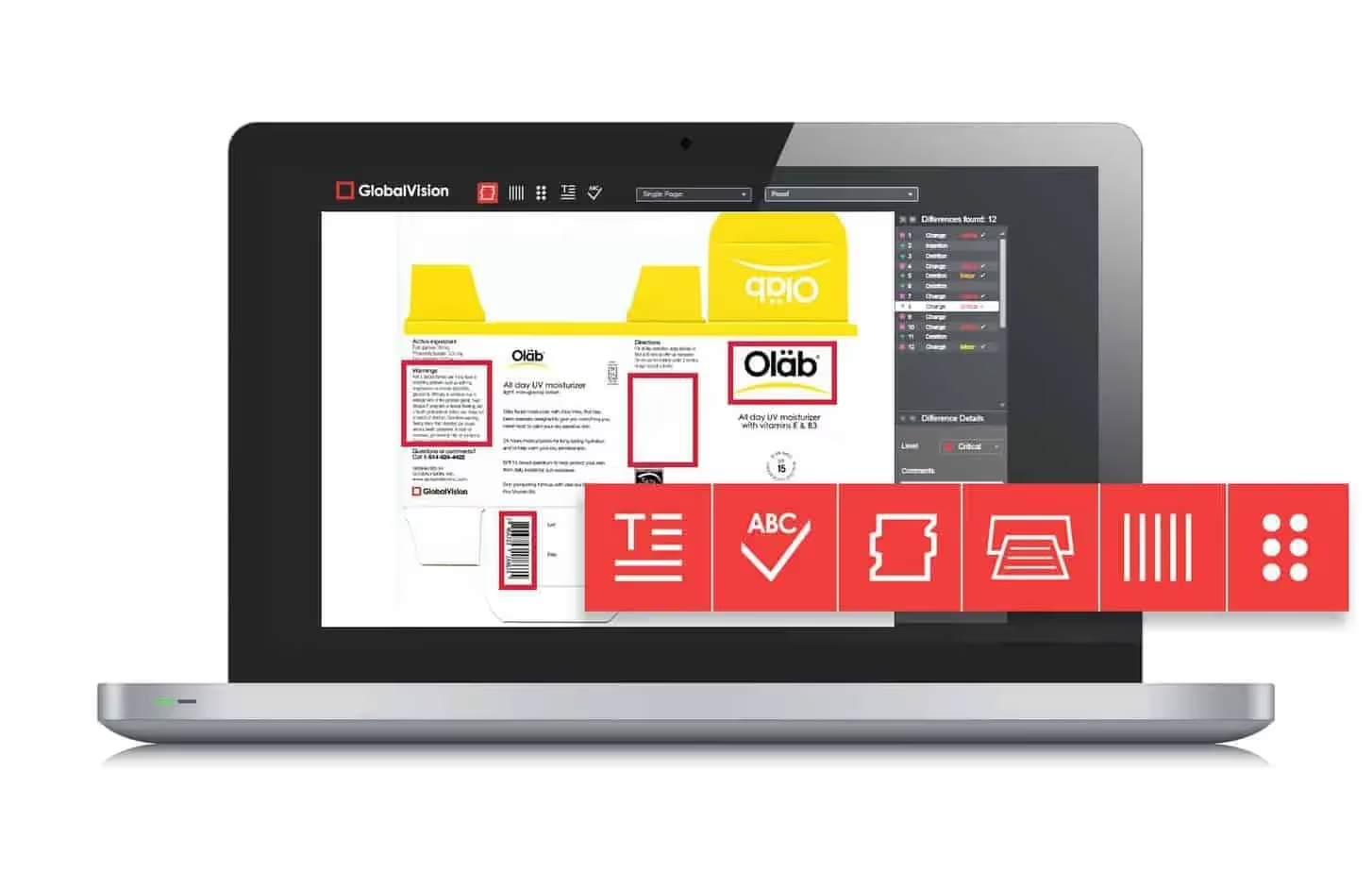
A nova tecnologia está voltada para serviços tudo-em-um. Por exemplo, a GlobalVision e a Esko uniram forças recentemente para desenvolver a primeira ferramenta totalmente automatizada, de controle de qualidade tudo-em-um que permite às empresas de embalagens otimizar todo o processo de revisão e detectar cada erro no fluxo de trabalho, desde pontos ausentes até mudanças de cor.
Agora, o Automation Engine Suite 16 da Esko vem com as ferramentas de texto, gráfico, Braille da GlobalVision, código de barras, e inspeção ortográfica ferramentas, permitindo ao utilizador criar fluxos de trabalho personalizados e programar inspeções automatizadas em cada etapa do processo.
Conclusão
O papel da pré-impressão mudou drasticamente na última década. Com o grau de integração que foi alcançado, não apenas na pré-impressão, mas em todos os departamentos do negócio de impressão, a pré-impressão tornou-se o fator decisivo para um fornecedor de serviços de impressão entregar o mais alto nível de satisfação aos seus clientes, ao mesmo tempo que mantém alta rentabilidade.
As gráficas de alto desempenho são aquelas que investiram na integração total e agora entendem que os benefícios virão quase imediatamente. A tecnologia de pré-impressão está a mudar radicalmente o panorama para as empresas de embalagens.
Fluxos de trabalho automatizados são a forma mais simples e eficaz de proteger o seu trabalho em cada etapa do processo. Se as empresas não começarem a adotar e a abraçar novas tecnologias, poderá chegar um momento em que não conseguirão competir com outras empresas totalmente automatizadas.
GlobalVision é o principal desenvolvedor de tecnologias de revisão para produtos embalados de varejo e farmacêuticos
Saiba como GlobalVision tem ajudado empresas de impressão e embalagem no controle de qualidade.
Saiba mais sobre Tipos de Provas de Pré-impressão